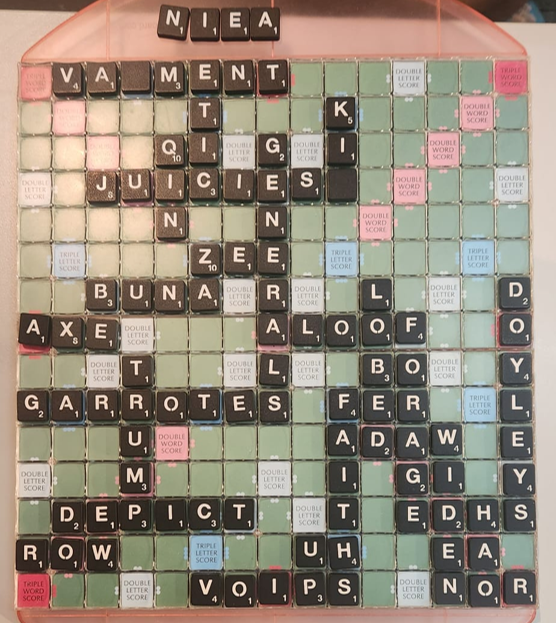
Some people believe that how the first game goes is a sign of how the tournament as a whole will be for you. In Round 1, as one of the higher seeds, I was paired against a lower-rated opponent. Despite trailing badly for most of the game, I staged an incredible comeback at the end. First, my opponent opened up for my homeless VERDANT, which let me cut the deficit but still left me in arrears.
My next draw of DELOUYY looked bad, but I saw that if my opponent kept to the adage of not emptying the bag, I would be able to play the U and, by drawing the last S, threaten the winning out-bingo of DOYLEYS, which my opponent might not see or figure out how to block.
The last turns of the game went exactly as I projected, resulting in one of the most unlikely and memorable wins I have ever had. This astonishing series of events left me convinced that it was my year to win.
Now, you might be thinking that I was right, since I did in fact win the 2026 Nationals. However, the game I just described was against Gabriel Cheang in the opening round of the 2024 Nationals, which I did not win, falling short in the final game against eventual winner Jian Rong to finish second. The 2026 Nationals began quite differently. Like in 2024, I drew badly in the first round; unlike in 2024, I did not make the most of the opportunities I did have. In the early going, I held AEEIIRT and saw AEGIRITE and INERTIAE as potential solutions to ?AEEIIRT, but those weren’t available. However, I missed (M)ETAIRIE, and instead played REAI(R)* for 18 points, which was somehow left unchallenged1. I then proceeded to lose the game by 200 points. This was not the most auspicious start to the tournament.
I recovered slightly by winning the next two games, but I was hapless in Game 4 as my opponent bingoed five times and I simply couldn’t keep up, losing by 100+ despite three bingoes of my own. Thus, I ended the first morning with a mediocre record of 2-2, -65.
At this point, I certainly wasn’t thinking about winning the tournament. However, I also wasn’t particularly upset. Two years ago, I had put a lot of pressure on myself as I felt like I was drawing well enough to win the tournament and I didn’t want to waste my chance. This year I was fine with a mediocre finish if the tiles didn’t go my way.
My bad luck extended into the lunch hour. As a fried carrot cake obsessive, I decided to try out a well-known carrot cake stall near the venue, but it turned out disastrously, as the dish was bland and flavorless despite the good reviews.
Fortunately for me, however, the bad luck did not extend any further, as after lunch, I won the last four games of the day fairly easily. I drew into a disproportionate number of bingoes and high-scoring intermediate plays, while my opponents mostly lacked the tiles to put up significant resistance.
In one game, I also got lucky in a different way: my expert opponent (who shall remain unnamed) uncharacteristically missed a relatively simple bingo that would have given him good chances to win. Thus, I ended the day in fourth place with a respectable record of 6-2, +309, behind the leaders only on spread.
After a good night’s sleep, I opened the second day with three more wins. I don’t recall the details of how Game 9 unfolded, only that it was a comfortable win for me. Game 10 against Jeya was more testing. He opened with OCELLAR to put me at an early deficit, but I got back into the game with CRASHES, followed by correctly pulling the trigger on PAVONIAN, which I had some doubt about.2 I then bingoed twice — once with each blank — and was able to win by ten points in a close game, despite some inaccurate plays.
Game 11 against Wolfram was another comfortable win, as I bingoed with FaRTHER, UTERINE, and ACIDE(MI)AS on three of the first four turns to take a 200+ point lead, after which it was relatively straightforward to protect my lead.
This set up the first of my three games on stream which you can watch here [linkair]. In Game 12, I was lucky that my opponent missed UPDATIN(G) because he was fixated on looking for a possible triple-triple in the spot I had just opened. I was able to take a narrow lead entering the pre-endgame, where I was faced with this board position:
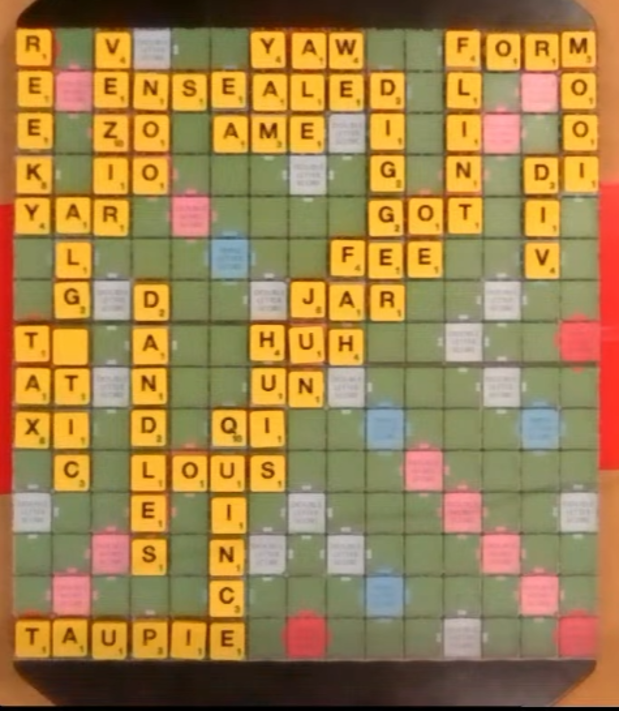
Here, I was leading by 45 holding ?BOPSTW with ABEENRRT unseen. As I was not far ahead enough to survive a bingo, I needed to block potential threats without giving back anything new. After some thought, I found a play that wins 100% of the time, putting me two wins clear of the field with four rounds left to play3.
For lunch, I decided that I would have carrot cake again, since it seemed to have worked well yesterday, so I visited a different well-known carrot cake stall near the venue (apparently, there are several). This time, I benefitted from my choice both in terms of gustatory pleasure and in terms of lucksack.
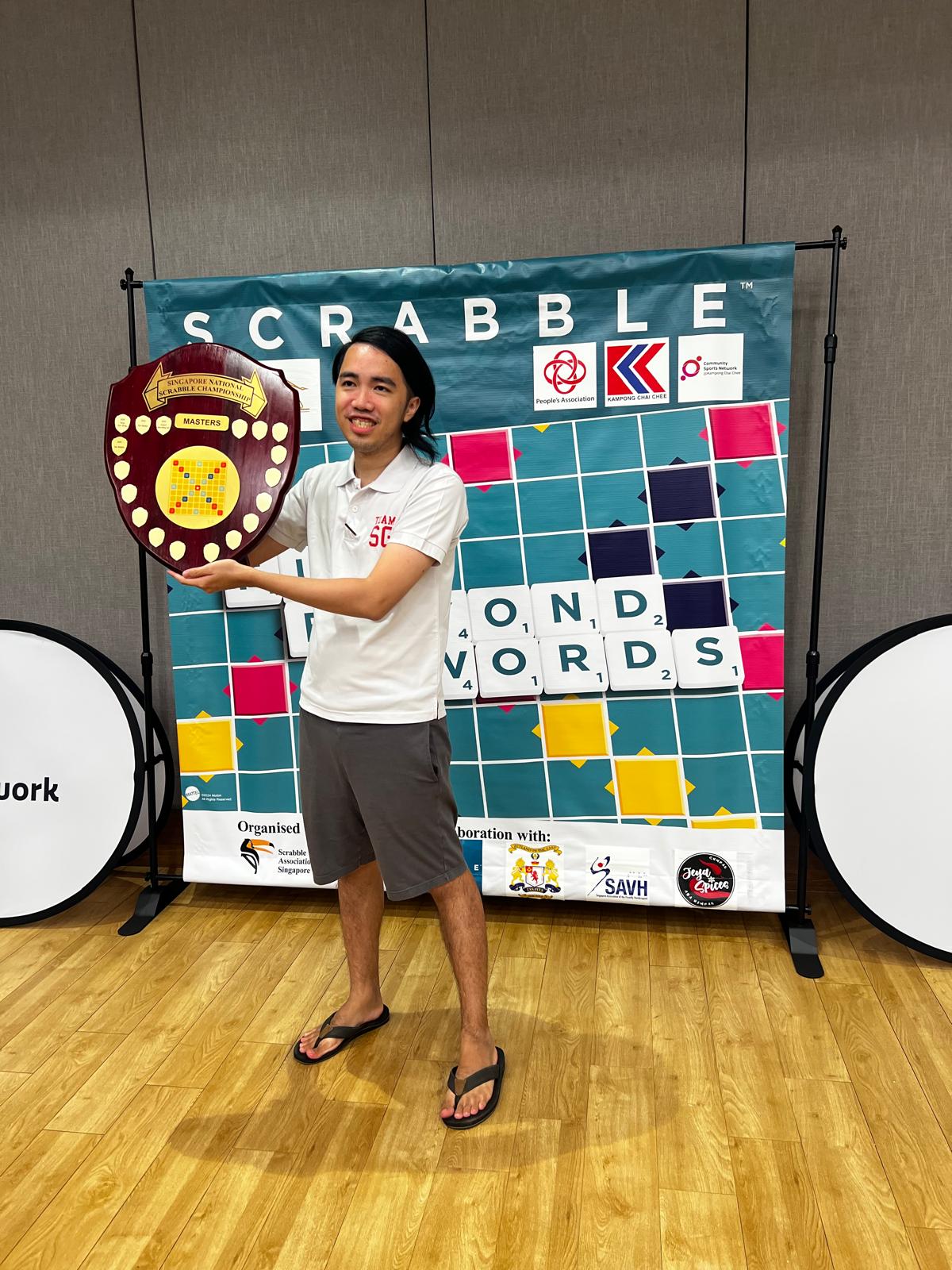
Not only was the carrot cake much more to my liking, I completed, for the first time ever, a winning streak of ten consecutive games in one tournament to become National Champion for the first time, and did it with two games to spare.
I then proceeded to play terribly in the final two rounds, missing multiple bingoes in both. Since the results were meaningless except for ratings, I couldn’t bring myself to take the games too seriously. (It’s a good demonstration of how important stress and nerves are to perform well!)
To be completely forthright, winning this event did not make me particularly happy. The way that I won felt rather anticlimactic, as I overpowered multiple opponents with very imbalanced draws rather than relying on my strategic abilities.
I started with bingoes in nine out of 16 games and drew way more than 50% of the blanks – enough that I didn’t bother counting my blanks drawn. While most readers may find this not all that relatable, I personally don’t get too much satisfaction out of playing bingoes unless they are extremely low probability (better yet if they don’t contain any blanks).
For example, two of my better finds during Nationals were PAVONIAN and MALAXED, but those don’t feel too different from playing simpler bingoes like RETINAS or SEALINE to me.
This reflects, at least in part, the type of complex emotional relationship that many top players4 have with Scrabble — though, to paraphrase Tolstoy, each such relationship is complex in its own way, and I can speak only for myself.
Although I had recently started taking word study much more seriously, I saw this purely as a means to an end, and indeed get little to no enjoyment from studying.
I was moved and grateful that the commentators on the live stream made sure to mention my word study efforts and congratulated me on those efforts paying off, but it’s nevertheless not something that I find satisfying for its own sake. As a result, winning because I was finding bingoes more consistently did not feel like an accomplishment to me.
At this point, you may have the impression that I don’t actually enjoy playing Scrabble all that much, which is not the case. It’s more that the way in which I won this tournament was not what I would have preferred (though I do prefer winning to not winning!)
In 2024, one major factor in why I lost the critical final round was probably that I played worse due to nerves. I wanted (still want) to prove to myself that I can win tournaments even when everything isn’t going my way and I have to deal with the stress and pressure of any mistake being potentially tournament-ending. Although I did win this year, I don’t think I managed to do that. I hope, of course, that I will be able to prove myself in the future.
Thanks to the Scrabble Association, Singapore for inviting me to share my reflections on Nationals 2026.
- This play was egregious for many reasons, not least because I know full well that AEGIINRR is GRAINIER and not REAIRING*. When considering the validity of shorter words, it often helps to consider if you know whether a longer inflection of the word is valid. ↩︎
- CRASHES was actually terrible; I misremembered ACEHRSS as a singleton and overlooked CHASERS and ESCHARS, both of which would have been better, and was duly punished because CRASHES ceded PYLORI(C) for 50+. ↩︎
- There is a 2/8 or 25% chance that my opponent has (C)ABERNET, which must be blocked with something like (C)OWP or my choice of (S)O(N)S, which is a pretty funny play using my only vowel and my S to score 5 points. ↩︎
- For the purposes of this discussion I will presumptuously count myself as a top player. ↩︎